Havant History: Parchment, Springs, St Faith's and the Railway
From a spring called Hamanfunta to a parchment works, a market charter and the 1858 railway quarrel known as the Battle of Havant: the main chapters of Havant's history.
Havant grew around a spring (recorded as Hamanfunta around 935 CE), became a market town after a market right was granted in 1200, was known for parchment making until 1936, and was the scene of the 1858 railway dispute called the Battle of Havant, all according to Wikipedia.
A short history of Havant
Havant is an old market town whose story starts with water. This guide pulls together the main chapters, using Wikipedia's Havant article for the dates and The Spring's heritage pages for what you can see and do locally. Where a date comes from Wikipedia, it is attributed to it, and a few details on that page are marked there as needing a citation, so we have left those out.
Where does the name Havant come from?
Wikipedia says Havant was known around 935 CE as "Hamanfunta", meaning the spring of Hama, and that this refers to the spring south-west of St Faith's churchyard. It adds that a settlement grew at the crossing point of a track from the Downs to the coast and another running east to west along the coast. In 1086, at the time of the Domesday Book, Wikipedia gives Havant as a village with a population of around 100.
Is there Roman history in Havant?
Yes. According to the same article, archaeological digs in the 19th and 20th centuries found evidence of Roman buildings near St Faith's Church and in Langstone Avenue, along with Neolithic and Mesolithic remains. It describes the old centre as a classic crossroads, with North Street, East Street, South Street and West Street meeting at St Faith's, and says one axis is a known Roman road with a few artefacts suggesting the other may be too.
How did Havant become a market town?
Wikipedia says that in 1200 the monks of Winchester Cathedral were granted the right to hold a market at Haveunte, and that around 1450 an annual fair was held on the feast of Saint Faith. It also says that for much of its history water played a vital part in local commerce, with many water mills, parchment manufacture and brewing.
The same article says much of Havant was destroyed by fire in 1760, leaving only the church and the adjacent cottages that are now known as The Old House at Home, a pub that we mention only as a landmark. It says the fire allowed roads to be widened and made it easier for stagecoaches to pass through the town, and names the Bear Hotel and Dolphin Hotel as notable coaching inns.
What was Havant's parchment industry?
Wikipedia says there are several natural springs in the area, including one a short distance south-west of the church on West Street at the end of Homewell. It says this was the home of the premier parchment making facility in southern England until it closed in 1936, and that the site later became a glove making factory and a leather processing plant. The article also says the Treaty of Versailles was written on Havant parchment.
You can visit the spring today as part of The Spring's self-led heritage walks. Its "Springs and Streams" walk is a 3 mile circular route that should take around 2 hours and starts and finishes at Homewell spring, and the page links to the directions to download.
What is St Faith's Church?
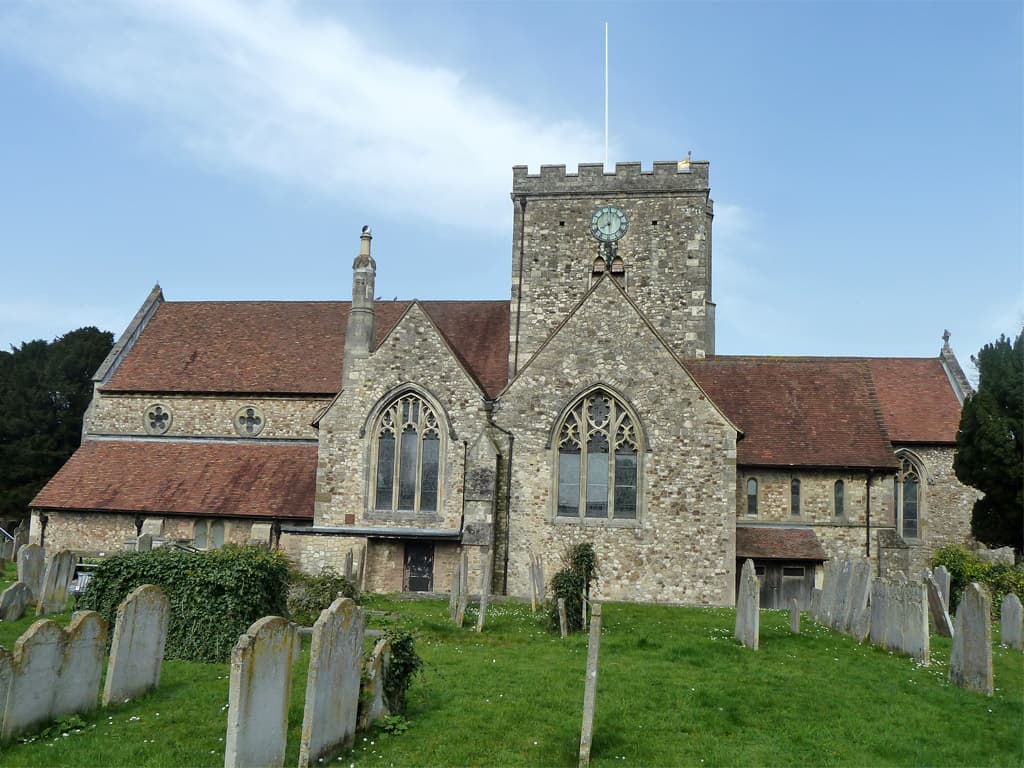
Wikipedia calls St Faith's the town's Church of England church, with parts dating back to the 12th century. It says the oldest undisturbed parts, such as the chancel, date from the early 13th century, with some foundations believed to be Roman, and that the vestry is 14th century. The article also mentions a monumental brass to William Aylward, dated 1413. St Faith's stands at the crossing of the four main streets, so it is easy to find on foot from the station or the car parks. For listing details, check the Historic England list rather than relying on this summary.
How did the railway change Havant?
Wikipedia says Havant was connected with a station on the railway to Portsmouth and Brighton via Chichester in 1847, followed by the Portsmouth Direct Line to London in 1859, and that the branch line to Hayling Island ran from 1867 until the mid-1960s. Our Havant train station guide covers the modern station.
What was the Battle of Havant in 1858?
It was a railway quarrel rather than a fight. Wikipedia's article on the Battle of Havant says that in 1858 two local railway companies started the "Battle of Havant". The London, Brighton and South Coast Railway ran the London to Portsmouth line via Hove and refused to let the London and South Western Railway use its track to reach Portsmouth. The London and South Western Railway had permission to run trains to Portsmouth on the Portsmouth Direct Line, but the track between Havant and Portsmouth belonged to its rival.
According to the article, the Brighton company blocked the line just north of the intended junction, and the South Western company opened a temporary station called Havant New on 1 January 1859, between Havant and Rowlands Castle. It lists the station as closed on 24 January 1859, and says the two companies later reached an agreement. The article does not give a single clear account of the timing, so treat the exact sequence with care.
Where can I learn more in person?
The Spring houses the Havant Museum, and its heritage collection page lists displays on the Hayling Billy line, famous local brands including Scalextric, Tampax and Kenwood, and Royal Doulton tile panels from the Havant War Memorial Hospital children's ward. The Havant Heritage Trail leads you across the town using plaques on the buildings or a physical guide that can be collected from The Spring. The Havant Local History Group meets there on the first Saturday of the month, 10am to 12 noon, with sessions free to attend but booked in advance. For the venue itself, see our guide to The Spring.
Share this article